

When it comes to SEO, keywords, backlinks, and content are the matters of attention of many people. However, page speed is as important. The fact that a site loads slowly will not preserve the good content since the visitor will abandon it. Google has already realized that, page speed matters in search ranking. We will discuss the reasons why page speed is important and how it has a direct impact on the performance of your website, its ranking in the search engines and experience of your users.
1. First Impressions Matter

A potential customer will generally be introduced to your site as the initial thing. When it takes over a few seconds to load, then the majority of the people are going to simply click off. Research indicates that visitors who are more than half of the total population abandon the site when a page takes longer than 3 seconds to load.
Why this matters for SEO:
Google desires to provide the users with the best experience. When users continue to abandon your site because of the slow speed, then Google believes that your Webpage is not satisfying as per the expectation. That will reduce your rankings in the long run.
2. Page Speed Is a Confirmed Ranking Factor

Google has indicated that speed of a webpage is one of the factors of ranking of sites. It began to use desktop page speed in 2010 and mobile speed in 2018 when it introduced the Speed Update.
This means two things:
- In the event that your site loads slowly, it may be relegated to the search results.
- The faster your site loads, the higher you stand a chance to rank higher particularly on searches on mobile.
The Core Web Vitals at Google check the time needed to load a page (LCP), the response time to clicks (FID), as well as the appearance of the page (CLS). A poor rating in any of these may damage your search engine optimization despite having an excellent content.
3. Better User Experience = Better Rankings

The search engines desire to present pages that are liked by individuals. A fast-loading site will ease the process, alleviate frustration, and allow the visitor to find what he or she needs fast.
When you go searching on Google and you click the result and the page loads in 10 seconds, what will you do? You hit the back button. When this occurs repeatedly, Google gets to know that people desire faster alternatives.
By improving page speed, you:
- Reduce bounce rates
- Extend average time of session.
- Promote the visiting of additional pages.
All these user behavior indicators contribute towards improving the overall performance of your site in terms of search.
4. Mobile Performance Is Now Critical

Phones contribute more than fifty percent of all traffic of the internet. Google has now started to index in a mobile first format, this means that it primarily reviews your mobile site when determining the ranking of your website. A fast-loading site on a computer may become a very slow site on a phone, and lose lots of visibility on the search list. The networks that phone users use are usually slower making every second that a page has to take to load count. Mobile optimized and speedy site is ranked higher and retains traffic.
5. Page Speed Impacts Conversions

The speed of pages is regarded as important to your money and not only SEO. Delays on pages translates to loss of customers. Amazon estimated that even one second delay would cost them billions. Still, regardless of whether you are Amazon or not, the concept remains the same, the slower the site, the more customers you will lose.
When the mobility of people is made possible across your site, they will tend to:
- Fill out forms
- Make purchases
- Book services
- Stay longer and return again
Google favours the fast and convenient sites and the speedier sites tend to sell more.
6. Speed Affects Crawl Efficiency

There is also the crawl budget of Google bots whereby they are limited to a certain number of pages on your site within a period. When your site is slow, Googlebot will not have the opportunity to visit as many pages hence you may see:
- There are other pages that are not indexed.
- Delay in new content to be listed in search results.
A quicker site will also allow Google to crawl and index more pages enhancing your general SEO presence.
7. How to Improve Page Speed

Improving your site’s speed isn’t just a one-time fix; it’s an ongoing part of technical SEO. Here are some practical ways to make your site faster:
- Optimize images: Compress and use the right formats (WebP for modern browsers).
- Enable browser caching: Store files locally so repeat visitors load pages faster.
- Minify CSS, JavaScript, and HTML: Remove unnecessary code and whitespace.
- Use a Content Delivery Network (CDN): Serve content from the nearest server.
- Eliminate render-blocking resources: Make sure critical content loads first.
- Use lazy loading: Load images and videos only when they’re needed.
- Upgrade hosting: A good server can make a huge difference in load times.
Google’s PageSpeed Insights and Lighthouse tools are great places to start measuring and optimizing your performance.
8. Page Speed Gives You a Competitive Edge
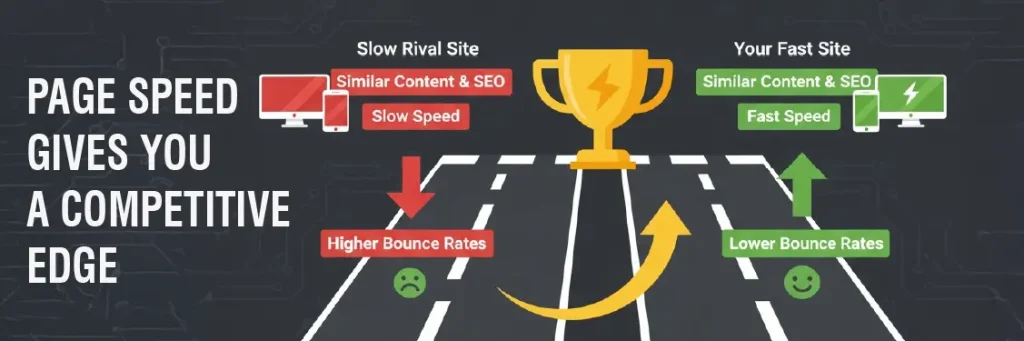
In competitive industries, small improvements can push you ahead of your rivals. If two sites have similar content and backlink profiles, the faster site usually wins. Speed creates a better experience, lowers bounce rates, and makes your site easier to crawl — all factors Google rewards.
Final Thoughts
Page speed isn’t just a technical detail — it’s a crucial part of your overall SEO strategy. A fast website improves rankings, keeps visitors engaged, boosts conversions, and helps search engines index your content more effectively. If you want to climb higher on Google and stay ahead of competitors, optimizing your website speed is a must. This is where SEO Tech Experts can help. Our team specializes in technical SEO and page speed optimization to make your site not just search-friendly, but lightning fast.