Think about how you used to find a restaurant. You’d type something like “best restaurant near me” into Google and scroll through a list of links. That habit is changing fast. Today, people open ChatGPT, Gemini, Google AI Overviews, Yelp Assistant, Microsoft Copilot, Perplexity, and other voice assistants to get recommendations. “Which seafood restaurant in Dubai is good for a business dinner?” or “Locate a family-friendly lunch spot near me with parking.”
Changing the way individuals search for options on search engines equally calls for a more integrated SEO approach for restaurant owners. This trend itself asking new restaurant owners to follow AI SEO, GEO, and AEO for their restaurant business growth strategy. It is no longer just about showing up on Google’s first page. It is about making your restaurant easy for AI platforms to find, understand, trust, and actually recommend to someone.
Which AI Platforms Do People Use To Find Restaurants?
ChatGPT and Apple Intelligence
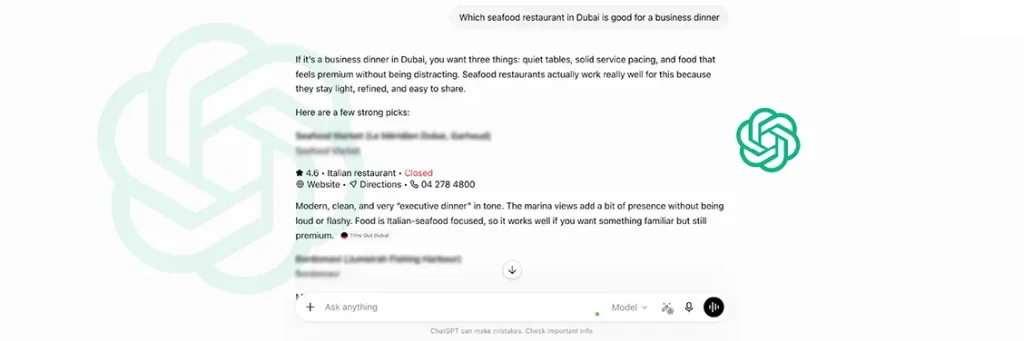
ChatGPT has quietly become one of the most common places for people when they want a dining suggestion. Whether someone is planning a date night, searching for a family-friendly spot, or craving a specific cuisine, they ask ChatGPT in the same way they’d ask a well-traveled friend.
What this means practically is that your restaurant’s website, listings, reviews, local citations, and menu data all need to be accurate and consistent across the web. A solid presence can also support visibility in AI experiences connected with Apple Intelligence and voice-based search, which more people are using on their phones every day.
Google AI Overviews, AI Mode and Gemini

Google is not going anywhere. Diners still check Google Search, Google Maps, reviews, photos, menus, opening hours, and directions before deciding where to eat. What has changed is how Google delivers that information. Google AI Overviews and AI Mode now summarize restaurant details right inside the search results, so the user may never need to click through to your site.
Gemini leans heavily on Google’s own ecosystem, aka your website content, Google Business Profile data, local listings, reviews, photos, and search signals all feed into what Gemini knows and recommends about you. Keeping your Google Business Profile complete with the right category, address, phone number, menu, photos, opening hours, services, reviews, and booking options is not optional anymore.
Perplexity AI

Perplexity is a widely used AI-first search engine that operates way different than a traditional search engine. It acts more like a researcher that pulls information from websites, local blogs, review platforms, forums, news articles, food critics, and social discussions and then presents a summarized answer with citations.
If your restaurant appears on credible food blogs, local guides, review websites, and restaurant directories, it stands a better chance of receiving citations and recommendations.
Microsoft Copilot and Bing
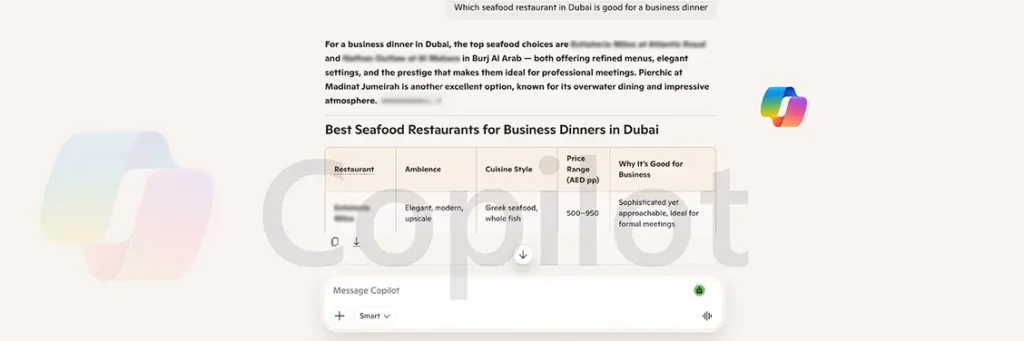
Microsoft Copilot delivers summarized answers with cited sources, while Bing continues to support restaurant discovery through its search and local listings. Because Bing data feeds into certain AI search experiences, ignoring Bing Places would be a mistake.
Claim and update your Bing Places listing with accurate business details, photos, your menu, timings, reviews, and your website link.
Yelp, Tripadvisor, Zomato and Food Platforms
Yelp, TripAdvisor, Zomato, Talabat, Deliveroo, OpenTable, and Resy are data sources that help AI systems to refer to and understand trust, menu quality, customer experience, delivery options, and booking availability.
These platforms directly support how AI systems perceive and recommend your restaurant.
What Kind of Keywords Do People Use in AI Search?
AI search is far more conversational than traditional SEO. Nowadays, people do not type short keywords anymore; instead, they describe their situation, their mood, their group, and their expectations in full sentences. Here are the patterns that actually show up:
When they make search according to location
“best cafe near me”, “seafood restaurant in Deira”, “shisha cafe in Dubai”, “coffee shop near Dubai Marina”, “Sports Bar Dubai”, “Indian restaurant near Downtown Dubai”, “Italian cafe Sharjah”, “Japanese Restaurant Burj Khalifa”, “Russian food Business Bay”
When the searches are based on Cuisines
“authentic Italian restaurant near me”, “vegetarian restaurant for chaat”, “Japanese restaurant with sushi menu”, “Arabic restaurant for family dinner”
When searches are made for different Occasions
“best part venue for birthday dinner”, “romantic cafe for date night”, family-friendly restaurant with outdoor seating”, “business lunch restaurants near me”
When we need special Amenities or Features
“cafe with free Wi-Fi”, “restaurant with parking”, “rooftop restaurant with view”, “late-night cafe open now”, “restaurant with vegan options”, “fine-dining restaurant with sea view”
Looking for Budget friendly Options
“Lunch deals”, “affordable restaurants”, “compare sushi restaurants by price and reviews”
Your restaurant pages need to genuinely answer questions around cuisine, location, menu, price range, ambience, opening hours, booking options, parking, dietary choices, reviews, and FAQs to strengthen AI SEO.
How do AI platforms recommend restaurants or dining options nearby?
Technically, a lot of insights go into consideration by AI search engines before recommending any restaurants nearby. From restaurant websites to social media platforms to other business listing sites, AI engines usually crawl every single online platform to fetch valuable insights and reviews around suggestions. Google My Business profile, Apple Maps listings, Bing Places, Yelp, Tripadvisor, Zomato & other delivery apps, food review forums, local directories, review sites, are among some platforms.
1. Accurate Business Information
When setting up your profile on Google or any other platform, it is required to ensure that your information is fully completed and entirely consistent across the web. This means your business details must match identically everywhere they appear, rather than just being correct in one isolated place. To achieve this accuracy, your profiles should always feature your complete restaurant name exactly as it appears on your signage, alongside your precise physical address, up-to-date contact details, and official website URL. Additionally, make sure to include your exact opening and closing hours, a current menu, high-quality interior and exterior photos of your location, and clear options for customer bookings and food delivery.
Even small inconsistencies matter. If your website and Google listing show different information, AI platforms may quietly decide not to recommend your business.
2. Website Content and Menu Details
Your website needs to clearly communicate what you actually offer. Important pages include the following:
- your menu,
- cuisine type,
- location,
- reservations,
- delivery,
- private dining,
- events,
- offers,
- FAQs,
- and contact details.
Don’t prefer either a PDF menu or an image-based menu. Build a proper HTML menu page where AI bots can actually read your dish names, descriptions, prices, ingredients, dietary options, chef specials, kids’ meals, vegan options, and popular dishes.
3. Schema Markup
Schema markup is how you give search engines and AI platforms a structured, machine-readable version of your restaurant data. It removes ambiguity and makes it far easier for AI to understand exactly what you offer.
Useful types include:
- Restaurant schema
- LocalBusiness schema
- Menu schema
- FAQ schema
- Review or Aggregate Rating schema, where valid
- Reservation-related schema
A schema can define your cuisine, price range, address, opening hours, menu URL, service options, parking, reviews, and booking availability, all in a format AI can use directly.
4. Reviews and Customer Language
AI platforms do not just count stars. They actually read review text to understand what kind of experience your restaurant delivers. Detailed, descriptive reviews help AI match your restaurant to very specific searches.
Useful reviews:
- family-friendly
- romantic ambience
- fresh seafood
- great business lunch
- vegan options
- outdoor seating
- good for birthday dinner
- quick service
- easy parking
A review saying “fresh grilled seafood, quick service, clean family seating, and easy parking” is more useful than a generic review saying “good food.”
5. Third-Party Mentions
Trust is not something you can claim for yourself; it has to come from elsewhere. AI platforms look at external sources to verify your reputation. Helpful sources include:
- food blogs,
- city guides,
- local news websites,
- hotel and tourism websites,
- restaurant directories,
- social media mentions,
- Reddit-style discussions,
- and independent “best restaurant” listicles.
Such kinds of well-structured blogs often act as a guide for AI and increase your restaurant’s cuisine, area, popularity, and dining experience.
AI SEO Strategies for Restaurants and Cafes
1. Build a Strong Restaurant Entity
AI needs to know exactly who you are. Not roughly. Exactly.
Your restaurant name, cuisine, location, price range, menu, opening hours, chef profile, awards, owner details, and brand story—all of it needs to match across your website and every listing you’re on. One platform says you close at 11pm, another says midnight; this inconsistency alone reduces how much AI trusts you.
Consistent data builds trust. Trust gets you recommended.
2. Optimize for Conversational Search
Nobody types “best seafood Dubai” into ChatGPT. They ask questions the way you’d text a friend who knows the city well.
Things like:
- Where can I book a seafood dinner in Dubai?
- Is there any cafe near me providing free Wi-Fi and parking?
- Which restaurant nearby is good for friends and families?
- Does this dining place offer vegetarian or vegan options?
- Can I reserve a table online?
- Is parking available?
These aren’t hypotheticals. These are actual searches happening right now. Put them in your FAQs, service pages, location pages, menu sections, and blogs. Answer them properly. That’s the game.
3. Create Location and Occasion Pages
One generic page for your whole restaurant. That’s what most places have. And that’s exactly why most places don’t show up.
Build pages around specific searches:
- seafood restaurant in Deira
- family restaurant in Dubai Marina
- business lunch in Downtown Dubai
- romantic dinner restaurant with outdoor seating
- brunch cafes near me
- coffee shop with Wi-Fi
Each page should cover location, nearby landmarks, parking, menu highlights, ambience, timings, booking options, and what a visit actually feels like. Don’t be vague. Specific pages for specific searches, and that’s how you get found.
4. Improve Review Quality
“Great food, loved “it”—that review does almost nothing for your AI visibility.
What actually helps is when customers talk about the parking situation, bring up that the outdoor terrace was perfect for a birthday dinner, and note the vegan options. That level of detail gives AI real context and real context is what gets you matched to the right searches.
Ask your regular customer to be specific. It makes a bigger difference than most restaurant owners realize.
5. Use Photos Properly
Upload real photos. Food, interior, exterior, your team, the dining area, events, the menu itself. Not stock. Not filtered beyond recognition. Real.
Then rename the files before uploading. seafood-restaurant-deira-dubai.jpg means something. IMG_4829.jpg means nothing to a search engine or an AI platform. Same goes for alt text — describe what’s actually in the photo.
Small habit. Real impact.
6. Get Featured on Trusted Sources
It feels great when someone else says you’re good.
Food blogs, local media, tourism sites, hotel guides, influencer pages, restaurant directories, and “best of Dubai” roundups such types of mentions matter. AI platforms notice when trusted third parties talk about you. They notice when they don’t, too.
Earn those mentions. They do work that your website simply cannot.
7. Keep All Listings Fresh
Wrong opening hours. Outdated menu prices. A booking link that goes nowhere. These things make AI platforms hesitant to recommend you because they can’t confidently verify what you’re offering.
Opening hours, holiday timings, menu prices, photos, offers, booking links, delivery links, contact details should get updated regularly. Every platform. Not just Google. All of them.
8. Audit AI Visibility
Most restaurants have never actually done an audit. This means that most restaurants have no idea where they actually stand.
Open ChatGPT, Gemini, Google AI Overviews, Perplexity, Copilot, and Bing. Search like a customer would:
- best restaurants near me for family dinner
- best cafe with outdoor seating
- romantic restaurant with sea view
- affordable Indian restaurant near me
- best seafood restaurant in Dubai
Who’s showing up? Is it you? If not, who is, and why? What are they doing that you aren’t? What sources is AI pulling from? What’s missing from your presence?
That audit tells you more than any guesswork. Do it, then fix what you find.
FAQs on AI SEO for Restaurants and Cafes
1. How can I get my restaurant recommended by ChatGPT?
Your website, Google Business Profile, Bing Places, menu pages, reviews, and listings all need to be accurate and current. Add a restaurant schema, detailed menu content, and FAQs, and get genuine third-party mentions behind you. ChatGPT recommends businesses it can verify — give it the data it needs to do that.
2. What is GEO for restaurants?
Generative Engine Optimization. It’s what gets you AI-generated answers on ChatGPT, Gemini, Perplexity, Copilot, and Google AI Overviews. Structured data, trusted mentions, strong reviews, accurate listings, solid menu content, conversational search queries — that’s the territory GEO lives in.
3. What algorithm do AI search engines use to find restaurants near me?
Well, a lot of platforms are being crawled by AI search engines in order to recommend you restaurants nearby. Some valuable AI platforms where your business must be represented wisely include:
- Website and Google Business Profile
- Map Location tags, customer reviews, business directories
- Delivery apps’ reviews, booking platforms, and guest blogs.
4. How does restaurant schema markup improve AI search visibility?
Because without it, AI has to guess what your business actually offers. Schema tells it directly your cuisine, address, hours, price range, menu URL, reviews, reservation options, and service details. That clarity is what separates businesses that get recommended from ones that get skipped.
5. How can cafes improve visibility in AI search?
Website, Google Business Profile, Bing Places, menu pages, photos, reviews, and local listings—get all of that right first. Then build content around how people naturally search. “Cafe near me,” “coffee shop with Wi-Fi,” “brunch cafe,” “outdoor seating cafe,” “family-friendly “cafe”—woven into your pages naturally, not stuffed awkwardly.
6. Should restaurants use PDF menus or HTML menus?
HTML. No contest. AI bots read HTML. PDFs and image menus are largely invisible to them. Put your dishes, prices, descriptions, ingredients, dietary options, chef specials, kids’ meals, and vegan choices in actual crawlable text. If it’s locked in a PDF, it basically doesn’t exist for AI search purposes.
7. How do reviews help restaurants appear in AI results?
AI reads the text of your reviews to understand what your restaurant actually offers. “Amazing experience, 5 stars” gives it almost nothing. A review that mentions the lamb chops, the rooftop seating, the parking, and the fact that the staff handled a large family group well—that gives AI real signals to work with.
8. Which platforms should restaurants optimize for AI visibility?
Different platforms offer different data signals. You can optimize your restaurant on these platforms—ChatGPT, Google AI Overviews, Gemini, Perplexity, Microsoft Copilot, Bing, Yelp, Tripadvisor, Zomato, Talabat, Deliveroo, OpenTable, Resy, Apple Maps, and Google Maps.
9. What are the best AEO strategies for restaurants?
FAQs that answer real questions. Schema markup. Clear HTML menu pages. Reviews with actual detail. Location-specific pages. Listings that are consistent and current across every platform you’re on. That’s it. No shortcuts, just doing those things properly.
10. How do I know if my restaurant is visible in AI search?
Go check right now. Search your category on ChatGPT, Gemini, Google AI Overviews, Perplexity, Copilot, and Bing. Try “best cafe near me,” “family restaurant with parking,” or “best seafood restaurant in Dubai. “If you’re not showing up—or worse, a competitor two streets away is showing up instead—you’ve just found your priority.